
Online Predators: How to Protect Your Child (2026)
This is the article nobody wants to need. The thought of an adult targeting your child online is every parent’s nightmare, so let’s say the frightening part once, clearly: online predators are real, they deliberately seek out children on games and social apps, and they are very good at sounding like a friendly peer. Now the more important part: they are also very beatable. Predators depend on three things — access, secrecy, and a child’s silence. This guide takes away all three.
The 60-second version: predators groom children through stages — friendly contact, trust-building, isolation, then exploitation. They find kids on games, social DMs, and chat apps. Your defenses: open conversations (so your child tells you), locked-down privacy settings (so strangers can’t reach them), and monitoring with new-contact alerts (so nothing happens in silence). Teach your child the non-negotiable rules: no private chats with strangers, no personal info, no gifts, no secrets — and “tell me, you won’t be in trouble” as the standing promise. For the monitoring layer, mSpy offers new-contact alerts and social media visibility from ~$11.67/mo annual.
🔍 Our #1 Pick for Visibility: mSpy
New-contact alerts, social media DM visibility, and keyword flags for grooming language — the visibility layer that keeps nothing in silence. 14-day money-back guarantee.
How Grooming Actually Works (The Stages, Plainly Explained)
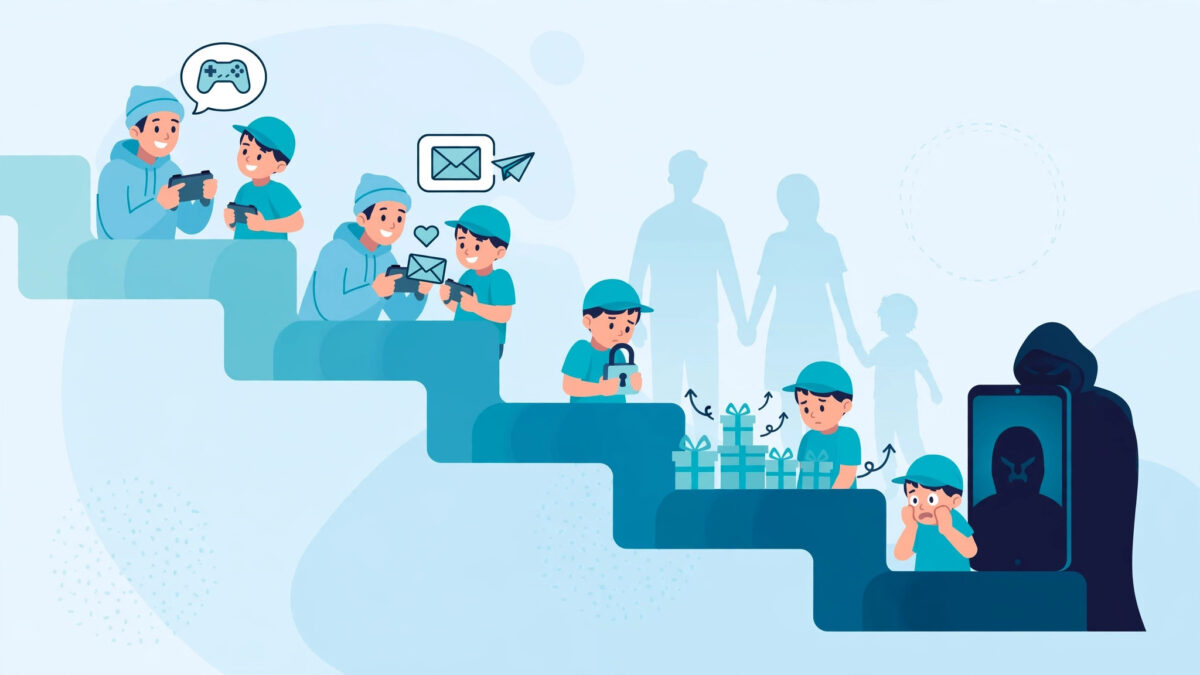
Predators don’t open with threats. They open with friendliness — that’s what makes grooming hard for kids to recognize and vital for parents to understand. Researchers describe a typical pattern in stages. Knowing the stages lets you spot it early, when it’s easiest to stop:
Stage 1: Access and friendly contact. It starts somewhere ordinary — a multiplayer game, a comment on a TikTok, a Discord server for a shared interest. The predator is friendly, funny, complimentary. Nothing alarming. To your child, this just feels like making a new friend.
Stage 2: Trust and specialness. The conversation moves to private DMs. The predator shows intense interest in your child’s life, agrees with everything, shares “secrets” to create fake intimacy. Your child starts feeling special — this person “gets me” in a way nobody else does. Compliments flow: about looks, maturity, talent.
Stage 3: Isolation. Slowly, the predator positions themselves against the child’s real world. “Your parents wouldn’t understand.” “Don’t tell your friends, they’ll be jealous.” They may badmouth the child’s family or friends to become the sole confidant. Secrecy is the load-bearing wall of the whole operation — everything before this was building toward it.
Stage 4: Desensitization and requests. The conversation turns sexual, gradually — jokes first, then questions, then requests for photos. Each step is small enough that the previous one made it feel normal. Gifts, game currency, or money may appear here as leverage and obligation.
Stage 5: Control and exploitation. Once the predator has compromising material or deep emotional hooks, the tone flips: threats to share photos, demands for more, instructions to keep quiet “or else.” By now the child is terrified — of the predator, of their parents finding out, of the shame.
Why this matters for you: stages 1–3 look completely innocent from the outside. That’s why “just tell me if anything weird happens” isn’t enough on its own — your child may not recognize weird until stage 4. The defenses that work are structural (privacy settings that prevent stage 1) and relational (a child who tells you about new online friends at stage 2, because that’s just what your family does).
Where Predators Find Kids (And What To Do About Each)

Predators go where children are. That means the apps your child already loves — not some dark corner of the internet:
Multiplayer games (Roblox, Fortnite, Minecraft). In-game chat and friend requests are the most common first contact point for younger kids. Defense: turn off chat with strangers (all three games allow this), set friend requests to friends-of-friends or off, and know that voice chat with strangers is the highest-risk feature — disable it for under-13s. Our gaming parental controls guide has the exact settings.
TikTok and Instagram DMs. Teens get approached through comments, duets, and direct messages — often by accounts that look like peers. Defense: private accounts, DMs restricted to friends/followers only, comment filters on, and regular follower-list prunes together. See TikTok Parental Controls and Instagram Monitoring.
Snapchat. Disappearing messages are attractive to predators for obvious reasons. Defense: contact settings to “My Friends” only, location sharing (Snap Map) set to Ghost Mode, and an explicit family rule about adding only people met in real life. Our Snapchat monitoring guide covers the details.
Discord and chat servers. Large public servers mix kids and adults freely. Defense: DMs from server members turned off (it’s a per-server setting many parents miss), no joining servers you haven’t vetted, and keeping server invites private.
The universal rule across all of them: review privacy settings together at install time, once, calmly. Not as a surprise audit — as a family ritual. “Let’s lock this down before you start” feels completely different from “give me your phone so I can check.”
Red-Flag Behaviors: What Grooming Looks Like From Your Side
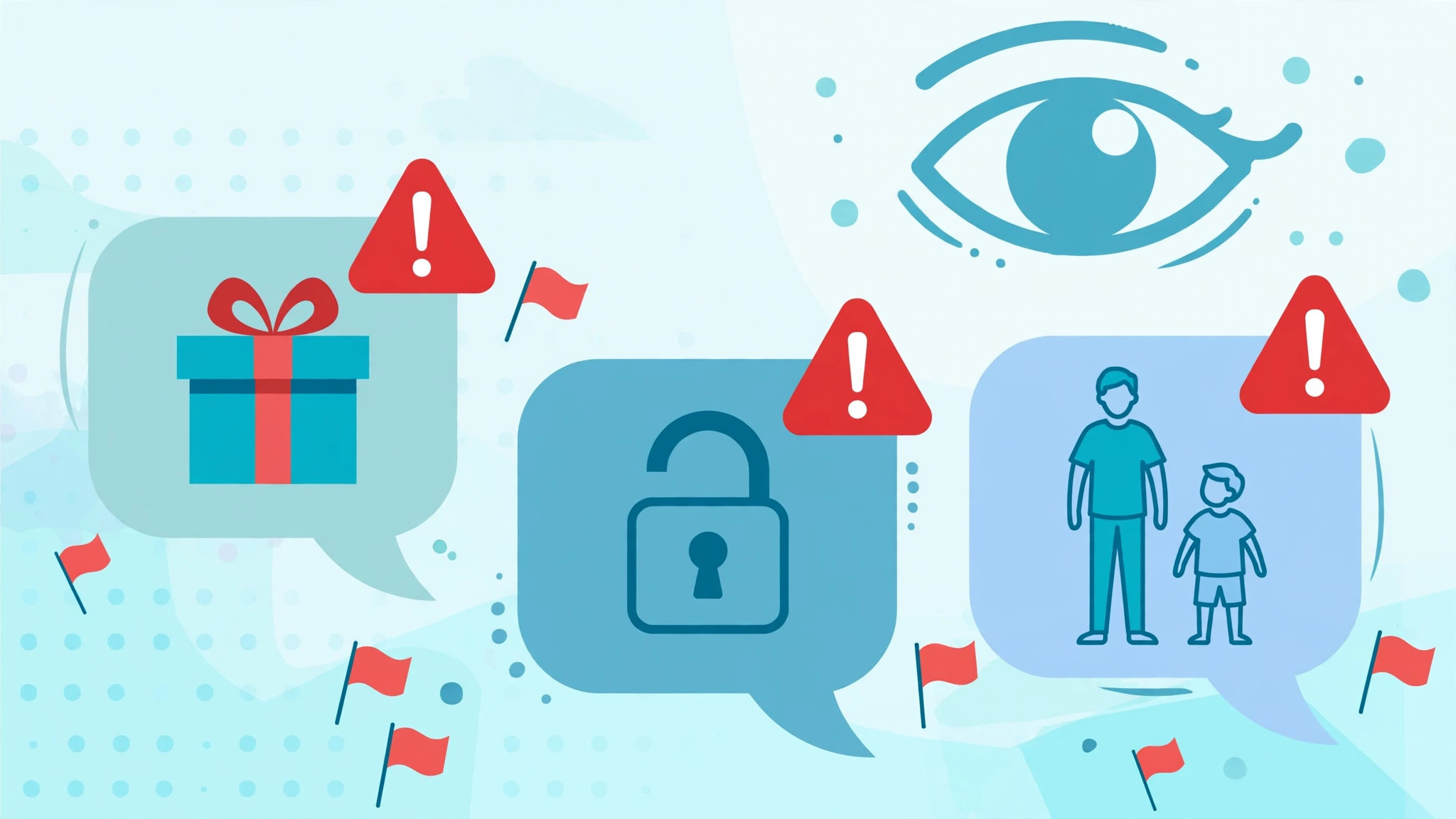
You probably won’t see the messages. You’ll see the effects. Any one of these deserves a calm, curious conversation — a cluster of them deserves action:
| Red flag | Why it matters | What to do |
|---|---|---|
| A new “friend” who’s much older, or whose age is vague | Age-gap friendships online are the single biggest predictor | “Tell me about your new friend” — then verify what you can |
| Secrecy about a specific person (not general teen privacy) | Isolation stage in progress | Don’t demand the phone — ask about the person, repeatedly, warmly |
| Receiving gifts, money, game currency, or phone credit | Classic leverage-building | This one warrants immediate, direct intervention |
| Sexual language or knowledge beyond their age | Desensitization stage | Stay calm. Ask where they learned it. Document. |
| Being told to keep secrets from you specifically | The load-bearing wall going up | “In this family, no one gets to tell you to keep secrets from me — ever” |
| Sudden new phone, second account, or secret app | Creating unmonitored channels | Discuss openly; second devices need the same rules |
| Withdrawing from family and real-life friends | Isolation succeeding | Rebuild offline connection deliberately; don’t just add surveillance |
| Fear or panic when messages arrive | Control/threat stage may be active | Believe them, promise no punishment, save evidence, consider law enforcement |
The most important row in that table is the second one. General teen privacy (“don’t read my diary”) is healthy. Specific-person secrecy (“you can’t know about Jake”) is not. Learn to tell the difference, and teach your teen the difference too.
👀 The Value Pick: Eyezy
Grooming thrives in silence — Eyezy breaks the silence with new-contact alerts and keyword flags on concerning language, plus location tracking and web history. From ~$9.99/mo annual, with a demo to explore first.
The Non-Negotiable Rules (Teach These Verbatim)
Every family needs a short list of absolute rules — few enough to remember, firm enough to hold. Teach these in your child’s own language, and repeat them yearly:
- No private chats with strangers. Public game lobbies with friends are one thing; moving to private DMs with someone you’ve never met in real life is where trouble starts. This is the single highest-value rule on the list.
- No personal info, ever. Full name, school name, address, phone number, location, photos in school uniform — predators assemble identity from scraps. “But they seemed nice” is exactly how the scraps get collected.
- No gifts from online strangers. Game currency, skins, money, phones — gifts create obligation, and obligation is leverage. If someone online offers your child something valuable, that’s a red flag, not generosity.
- No secrets from parents about online people. Make this a family law, stated plainly: “No one — not a friend, not a boyfriend, not anyone — gets to tell you to keep a secret from me. If they try, that’s the moment you tell me.”
- Nudes and intimate photos: never, for anyone, for any reason. And if someone asks: screenshot, block, tell a parent immediately — with the ironclad promise of no punishment for reporting. Teens need to hear “you won’t be in trouble for telling me” more than once for it to feel true.
- Trust the uncomfortable feeling. Teach your child that unease is data. “If a conversation starts feeling weird, you are allowed to leave it instantly — no explanation needed, no politeness required.” Predators exploit kids’ politeness; permission to be “rude” is protective.
Privacy Settings Checklist (Do This Together, Once Per App)
This is the highest-leverage hour you’ll spend on online safety all year. Sit with your child, open each app they use, and lock these down together:
For every social app:
- [ ] Account set to private (not public)
- [ ] DMs/message requests limited to friends/followers only
- [ ] Location sharing off (Snap Map → Ghost Mode, Instagram/TikTok location off)
- [ ] Discoverability off — not suggested to strangers, phone contacts not synced publicly
- [ ] Comment/message filters on (keyword filters for harassment and sexual content)
- [ ] Follower/friend list pruned — remove anyone they don’t know in real life
For every game:
- [ ] Chat set to friends only (or off for under-13s)
- [ ] Voice chat with strangers off
- [ ] Friend requests restricted
- [ ] Profile doesn’t reveal real name, age, school, or location
For the phone itself:
- [ ] App installs require parent approval
- [ ] Screen-time/location sharing active so you know where they are
- [ ] A shared understanding: new apps get the same lockdown ritual before first use
Frame it as teamwork, not inspection: “Let’s make your accounts stranger-proof together.” Kids who participate in the lockdown understand why each setting matters — which means they’ll keep the settings when you’re not watching.
What Monitoring Can (and Can’t) Catch
Honest expectations matter here. Monitoring apps are a powerful layer, but they’re not magic:
What monitoring catches well: new contacts and conversations you didn’t know about, keyword-flagged language (sexual terms, secrecy phrases like “don’t tell your parents”), late-night messaging patterns, location anomalies, and deleted-message recovery on some platforms. This is genuinely useful — it’s often the pattern (a new contact messaging at midnight) that alerts you before any single message would.
What monitoring catches poorly or not at all: grooming that happens on apps the monitoring doesn’t cover, coded language that evades keyword filters, voice chats (most monitoring is text-based), and anything on a second device or account you don’t know about. A determined predator who moves a child to an unmonitored channel defeats the software — which is why the rules and relationship layers matter more.
The right mental model: monitoring is the smoke detector. It doesn’t prevent fires, and it doesn’t put them out — but it wakes you up while there’s still time to act. The fire prevention is the conversation; the fire department is you, the school, and if needed, law enforcement.
🛡️ The Parental-First Layer: Parentaler
For families who want the safety net without the spy-plot feeling: Parentaler combines app blocking, web filtering, and location alerts in a dashboard designed for parents. Clean, calm, and effective — from ~$10.17/mo annual with a 14-day money-back guarantee.
If You Suspect Grooming: The Response Protocol

If the red flags are adding up, move deliberately and quickly:
Step 1: Stay calm in front of your child. This is the hardest step and the most important. Panic or rage will make your child protect the predator (“they’ll get in trouble because of me”) rather than accept your help. Your steadiness is what lets them cooperate.
Step 2: Believe them and remove blame. “This is not your fault. Adults who do this are skilled at tricking kids — that’s why it’s the adult’s fault, 100%.” Say it explicitly. Shame is the predator’s best ally; your explicit absolution is the countermeasure.
Step 3: Preserve evidence before anything else. Screenshots of everything — profiles, messages, usernames, photos sent, gift records. Save with timestamps. Do NOT delete the account or confront the predator yet; deletion destroys evidence and confrontation tips them off.
Step 4: Stop contact and lock down. Only after documenting: block on every platform, tighten all privacy settings, and check for other channels (second accounts, other apps) where contact might continue.
Step 5: Report. Report the account to every platform involved. Then report to law enforcement — and in the US, to the CyberTipline run by the National Center for Missing & Exploited Children. Provide your preserved evidence. Take it seriously even if “nothing physical happened” — grooming itself is a crime in most jurisdictions.
Step 6: Get professional support for your child. Even when grooming is caught early, the betrayal of trust wounds deeply. A therapist experienced with adolescents and online exploitation helps your child process it without shame. This isn’t optional-care — it’s part of the response.
Step 7: Care for yourself too. Discovering this is traumatic for parents. Talk to a counselor, a trusted friend, or a support group. You can’t pour steady support from an empty cup.
When to Seek Help (Beyond the Family)
- You suspect any sexual exploitation or extortion. Law enforcement, immediately — with evidence preserved. Don’t wait to be “sure.”
- Your child is being threatened. Threats to share images, threats of violence, threats against family — these are police matters, full stop.
- Your child is withdrawing severely or self-harming. Pediatrician or mental health professional right away, every time.
- The school community is involved. Counselor → principal → district, in writing.
- You’re unsure whether it’s grooming or “just a friend.” Trust the unease. A school counselor or child-safety professional can help you assess — asking is free, and being wrong about a false alarm costs nothing compared to missing a real one.
Frequently Asked Questions
The Bottom Line
Online predators are real, but they are not unstoppable — they’re opportunists, and opportunity is exactly what you’re removing. Locked-down privacy settings close the door. The non-negotiable rules teach your child to recognize the knock. Open, shame-free conversation means they’ll tell you when someone’s at the door. And monitoring means nothing happens in silence even when they don’t.
You don’t need to be a tech expert to do any of this. You need an hour for the privacy lockdown, ten minutes a week for the check-in, and the standing promise — tell me, you won’t be in trouble — repeated until your child believes it. That’s the whole defense, and it’s stronger than most parents realize.
For the full toolkit, see our complete parental control guide and the rest of this hub: cyberbullying and the safety hub home.
Legal note: install monitoring apps only on devices you own or your minor children’s devices in your care. This article contains affiliate links; we may earn a commission at no extra cost to you. Pricing changes often — confirm live pricing at checkout.
